Congratulations if you had “Justin Bieber sitting behind a MacBook at the world’s most famous music festival, searching his own name on YouTube in front of 100,000 people” on your Coachella 2026 bingo card. Get your prize.
The Canadian pop star’s headline set on Saturday night was one of the most highly anticipated performances in the festival’s 27-year history, by any standard. For months, the music business was buzzing about Bieber’s return to the big stage after years of health problems, canceled tours, and a very public retreat from the spotlight. All the tickets were sold out. Things sold out quickly. Kylie Jenner even wore Skylrk clothes. The stakes couldn’t have been higher.
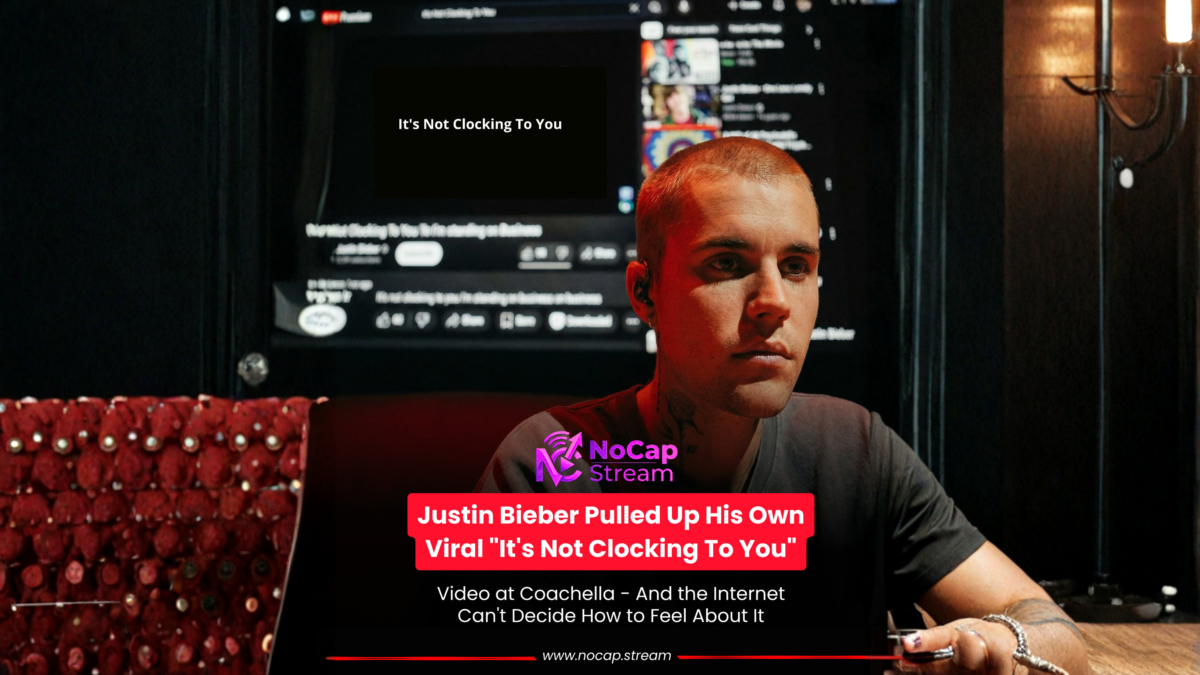
The crowd got something else. Something odd, very personal, sometimes brilliant, and almost aggressively unpolished. And right in the middle of it, about an hour in, when the air in the Coachella desert was still thick with excitement, Bieber sat down on a stool, opened a laptop that was connected to the main stage’s huge screens, went to YouTube, and pulled up the video that started a thousand memes: himself being confronted by paparazzi and cutting through the noise with nine words that have followed him ever since: “It’s not clocking to you that I’m standing on business, is it?”
The crowd went crazy. And the talk that followed has been going on ever since.
The Road to “Bieberchella”
To understand why that moment happened the way it did, you need to know how hard this comeback has been and how strange the road to Coachella was.
Bieber last played for this many people at Rock in Rio in Brazil in 2022. He had to cancel the rest of his Justice World Tour dates that year because he was diagnosed with Ramsay Hunt Syndrome, a rare viral disease that caused partial facial paralysis. In videos he shared with fans, he looked visibly shaken. He stopped talking. No tours, no big events, and no albums.
Then came 2025. Bieber dropped Swag, his seventh studio album, in July with little warning. It was the first album he made without his longtime manager, Scooter Braun. Swag II came out two months later. The double release was different: it was raw, personal, and had sounds from real life. One of the audio clips was of Bieber arguing with a paparazzo outside his house. It was a tense exchange in which he said the famous line about “standing on business” and not being understood. The phrase, which was cut up and shared over and over again on TikTok and X, became his unofficial rallying cry for the time. People have worn it on T-shirts, posted it in comments, and even printed it on the merchandise he sold at Coachella this past weekend.
Swag came in at number two on the Billboard 200. There were four Grammy nominations, one of which was for Album of the Year. The Coachella announcement came eleven days after Swag II came out. The 32-year-old was back, and it was clear that he was back on the biggest stage.
The Set: Brilliant, Baffling, and Somewhere in Between
Bieber’s $10 million Coachella set, which is said to be the highest performance fee in the festival’s history, started off simply and strongly, with a lot of Swag material. “Daisies,” “Yukon,” “Go Baby,” and “Devotion” were some of the newer songs that his most loyal fans had already memorized. He sang them with quiet intensity, and he seemed genuinely happy to be back on stage.
He played “Stay” with Kid Laroi about 30 minutes in, which was the first real nostalgic moment. The crowd moved. But then, and this is where the complaints started coming in on X, he went back to the newer catalog. This meant that fans of My World and Believe had to wait much longer than they had planned to hear the hits they had come to hear.
When those hits finally came, they came in a way that no one had expected. About an hour into the show, Bieber sat down on a stool behind a MacBook that was connected directly to the stage’s huge screens. He went to YouTube. He looked up his own name. And then, while the people at the Coachella main stage watched on the same screens that had been showing his performance, he started playing his own music videos and singing along with them, like in karaoke. “Baby.” “Don’t ever say never.” “Beauty and a Beat” Pieces of a catalog that has been around for more than 20 years, shown on the same platform that he used to upload videos when he was 12 and living in Stratford, Ontario, to get attention.
Then he looked for himself in a different way. Clips that go viral. Meeting with paparazzi. Old Vines from the early days of the internet. The video “Deez Nuts.” And then, to a roar that some say shook the whole Empire Polo Club, the full “It’s Not Clocking To You” video played on the main stage, with Bieber watching and smiling along with his fans.
Why That Moment Hit Differently
On the surface, sitting at a laptop during a $10 million headlining set and hitting play on a YouTube video seems like a huge mistake. And a lot of people on social media agreed. The backlash was quick, harsh, and sometimes even funny. “I’m crying; this might be the worst performance I’ve ever seen,” one viewer wrote on X. “He’s literally just playing music videos from YouTube… zero effort, just pure laziness.”
Another person wrote, “Something very sad and depressing about Justin Bieber speedrunning through all his old hits while sitting on a chair and playing parts of his songs on a laptop.”
But there was another side to the talk that you should pay attention to.
The “It’s Not Clocking To You” video was never just a meme. It was a real moment when Bieber, tired and clearly angry, tried to explain something to someone who wasn’t paying attention. He saw its potential, tried out its energy for Swag, made merchandise based on it, and now, on the biggest stage of his comeback, he chose to share it with a live audience as part of the show. That’s not being lazy. That’s an artist using his own mythology on purpose.
If you read it kindly, the whole YouTube segment was a callback to where he started: as a teenager, he uploaded videos of himself singing covers on a laptop, hoping someone would find them. Going back to that style on purpose at Coachella is either the most self-aware thing a pop star has done on a festival stage in years or a $10 million mistake, depending on who is watching. Both interpretations are justifiable.
The Merch, the Phrase, and a Moment That Came Full Circle
It’s worth taking a step back for a second to see the whole picture. “It’s not clocking to you that I’m standing on business” started as a raw, off-the-cuff moment with a paparazzo. It went viral as an audio clip. Then a sample from a Swag album. Then, there was a headline item: baby tees with the headline printed on them. They sold out at Coachella within hours and were worn by thousands of fans who flooded the festival grounds on Saturday. And finally, it was shown on the biggest screen at one of the biggest music events in the world, with the person it was about watching it live with everyone else.
It doesn’t really matter if Bieber’s Coachella set was “good” in the usual sense of the word—good setlist, high-energy choreography, and polished production. He wasn’t going after a standard set. He was talking about something. His tale. With a MacBook, a search bar, and a phrase that seems to tell time, since a whole generation of fans knows it by heart.
What Comes Next
Bieber is back in the news for Coachella Weekend 2 on April 18. No one knows for sure if the “YouTube karaoke” part will come back, get better, get cut completely, or somehow get even more out of hand. It seems like whatever version of the set ends up in the desert next Saturday, it will be on purpose—strange, personal, and messy, just like Bieber’s public persona has always been.
For a man who has been one of the most watched, criticized, and underestimated artists of the streaming era, coming back to the platform where it all started and hitting play on his own story is, if nothing else, a very Bieber way to do it.
It’s time to clock in. No matter what you wanted.
Sources: The Mirror US, CNN, Yahoo Entertainment, Washington Post, Time Out Los Angeles, Hollywood Life, TMZ, Elle Australia